

By Khrystsina Haranina
One of them left his mother a note saying he would come back in six months, and instead fled — through the jungle, at night, without a passport — not returning for a quarter of a century. Another realized that going back home would end in interrogation and chose not to take the risk. A third headed for the border after detention at Akrestina, not knowing whether he would even be allowed to leave the country. They lived in different parts of the world, spoke different languages, and found themselves in exile decades apart, but for the same reason. MOST spoke with journalists from Burma (now Myanmar), Azerbaijan, and Belarus who were forced to leave their homelands and continued working in exile.
Three paths to one decision
In September 1988, 23-year-old dental student Aye Chan Naing took part in anti-government protests in his native Burma. The country had lived under a dictatorship since 1962 and, over the course of 25 years, had become one of the poorest in the world.
Since 1989, the country’s official name has been Myanmar. We use the former name, which is closer to our interviewee and is still used in the brand of the media outlet where he works.
A currency reform in 1987 triggered a wave of protests. By 1988, tensions had reached a breaking point. Mass demonstrations across the country resulted in the deaths of thousands of people, and after they were violently suppressed in September 1988, a new military junta took control of the country. There are no precise figures: according to the most conservative estimates, around 3,000 people were killed; other sources put the number as high as 10,000.
“After what happened in September, it became clear that neither staying nor remaining silent was possible,” Aye Chan recalls.
He and three of his classmates decided to leave. They understood that no safe space remained in the country for open resistance, and that the only way to continue the struggle was to join student groups on the Thai-Burmese border.
The hardest part was explaining it to his family.
“I was the youngest child and, even though I was already 23, I was very attached to my mother. She begged me not to go to demonstrations, the risk of being killed was too great. That day I told her it would be the last time I went out to protest. Before leaving, I put a note under my pillow saying that I had already left the country, joined the armed resistance, and would return in six months,” Aye Chan says.
“Returning home was no longer possible”
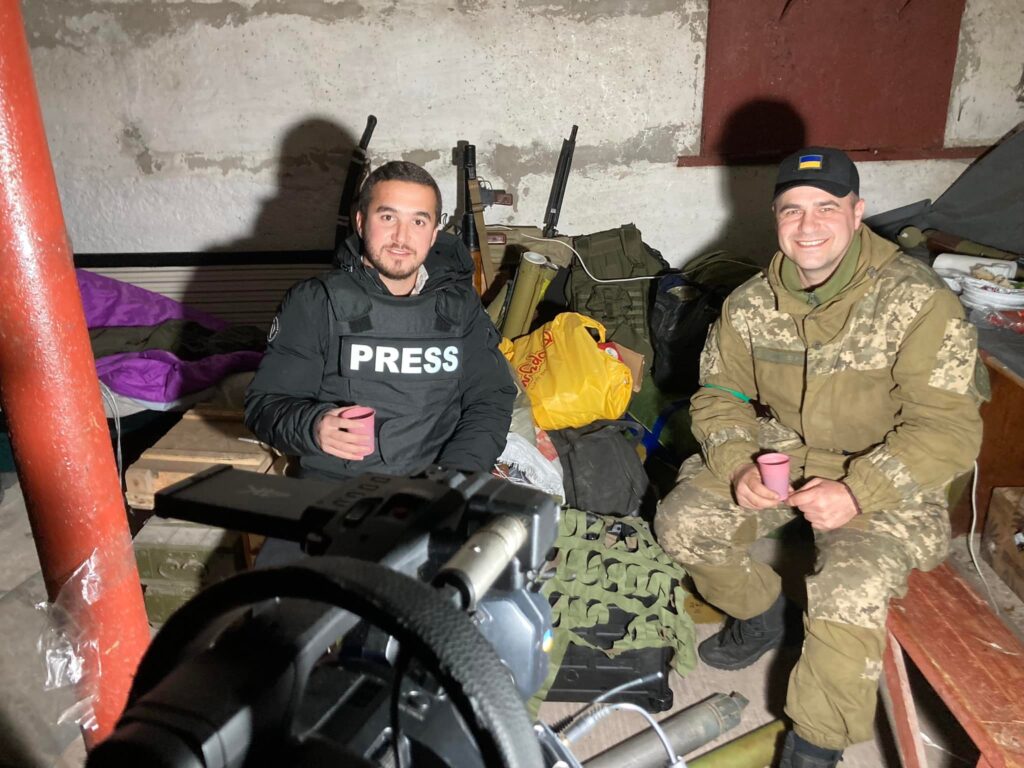
Courtesy photo of Orkhan Mammad covering the invasion of Ukraine.
Orkhan Mammad was born and raised in Azerbaijan. In 2015, he was studying abroad while pressure on independent media was intensifying in his home country. After the 2013 presidential election, the authorities began systematically suppressing any criticism, and independent media quickly found themselves at risk.
The situation worsened after the 2013–2014 protests linked to corruption and abuses within the military. Newsrooms were shut down, reporters were detained, and criminal cases were opened against journalists and activists.
By mid-2015, the authorities had launched a large-scale campaign against Meydan TV, an independent online media outlet with which Orkhan was associated. Journalists were summoned en masse for questioning, some had their equipment confiscated, others were banned from leaving the country. Arrests followed.
Criminal cases were brought under various charges, ranging from illegal business activities to tax evasion. Formally, these appeared to be financial investigations, but human rights defenders described what was happening as pressure on the independent press.
At first, Orkhan was in Georgia. His next stop was Italy, where he continued his studies. At that time, he still hoped he might at least return home briefly, but the situation only worsened: new charges were brought against his colleagues, journalists were stopped at the border, and any cooperation with independent media became grounds for persecution.
“I realized I couldn’t go back. It was obvious that it was dangerous,” Orkhan says.
Orkhan made the final decision not to return when Meydan TV offered him a permanent position in its Berlin office. It became clear that he could continue working as a journalist only outside the country.
“I realized that once I got out, they would come for me again anyway”
A sports journalist from Belarus remains anonymous due to the ongoing repression in the country. We will call him Valery. His path into exile began in 2021. By that time, he had worked in journalism for about 15 years, collaborated with various media outlets, and had not planned to leave.
After the 2020 elections, pressure on the media intensified sharply: colleagues were detained, newsrooms were shut down, and journalists were labeled “extremists.” Valery continued working until he himself ended up behind bars.
According to the Belarusian Association of Journalists, at the end of 2025, 28 journalists were imprisoned in Belarus. Forty-two independent media outlets and initiatives have been designated “extremist.” Over the past year, dozens of searches and new detentions have been recorded, and repression against the profession remains systematic.
Valery spent ten days in the detention center on Akrestina Street, and it was there that he realized he could no longer remain in the country.
“I realized that once I got out, they would come for me again anyway. There was no choice,” he recalls.
After his release, he needed several days to recover. Issues with his documents were resolved within about a week to ten days, and roughly three weeks after his release, Valery left Belarus.
The first step into the unknown
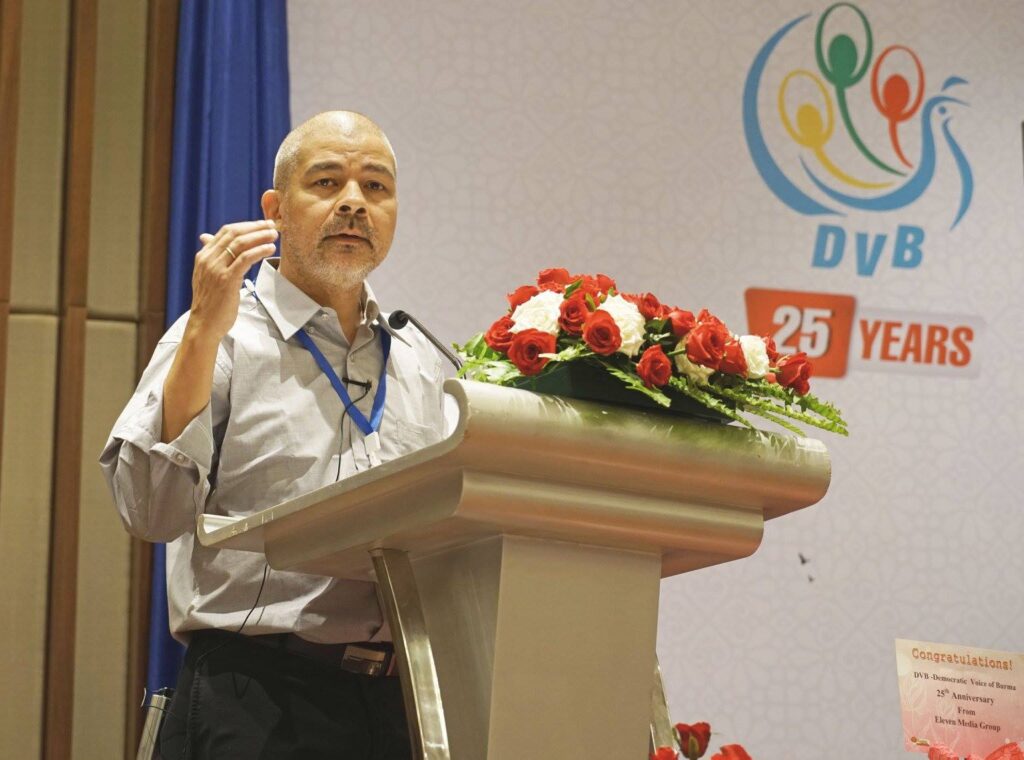
Courtesy photo of Aye Chan Naing at an event celebrating the 25th anniversary of DVB.
“We didn’t know him, and he didn’t know us. It was the only thing we had to hold on to.”
Crossing the border became the first and most dangerous stage for Aye Chan. He and his companions had no documents at all. They traveled with a guide who helped them bypass checkpoints and enter Thailand.
“We were led by a man who spoke Thai, and that gave us a chance to get through all the checkpoints. We simply got on buses and pretended everything was normal,” he recalls.
He does not describe that moment as a relief, but rather as the beginning of a new phase, one still filled with uncertainty. Aye Chan understood that he would not be able to return anytime soon, but he could not yet imagine how long his path in exile would be.
Their first stop was Bangkok, which the students reached with almost no money. A Swedish journalist was supposed to meet them there, his contact details had been passed on to them by acquaintances in Yangon, Burma’s largest city and former capital.
“We didn’t know him, and he didn’t know us. It was the only thing we had to hold on to,” Aye Chan says.
“Of course, I was really nervous at the border”
Valery recalls that on the day of his departure, news feeds were full of reports about detentions and searches targeting journalists.
His suitcases had been packed in advance. At the time, Valery still hoped he was leaving only briefly, for a couple of months, until the situation calmed down.
“Of course, I was really nervous at the border. But everything worked out,” he says.
The border guard carefully checked his documents, asked two brief questions, and let him through. Once they had crossed the border, the feeling that the move was temporary disappeared.
“When we got through, I felt only one thing: that was it, there was no way back,” Valery recalls.
From guerrilla fighters to journalists
After the first weeks in Bangkok, Aye Chan and other students headed to a training camp on the Thai–Burmese border. There they received basic military training and spent several months living among activists who had left the country after the protests.
“We learned how to shoot, we learned how to survive,” he recalls.
It was during this period that he had a meeting that would shape the rest of his life. The Swedish journalist Bertil Lintner, who had written for many years about Burma and the work of the opposition in exile, visited the camp. He explained to the students that the resistance needed not only fighters, but also those who would document events, record abuses, and convey information to the outside world.
“He said that our task was to provide information. And I realized that I could be more useful as a journalist,” Aye Chan says.
Soon, Lintner began giving him his first assignments: recording the stories of students who had fled, gathering information about those killed or missing, and documenting events along the border. These were simple reports, but it was through this work that Aye Chan first saw how information could influence international reactions and support for the Burmese movement.
Later, it was this very experience that brought him to Europe, where the Democratic Voice of Burma, a media outlet founded by Burmese journalists in exile, was established.
“There was simply no other option”
In Berlin, Orkhan found himself in an environment where a journalist could work without the risk of detention. In the first months, his life felt in limbo: his studies were still ongoing, his work at the newsroom was only just starting, and the future seemed uncertain.
The hardest part was constantly following the situation back home. Almost every day, he learned of new arrests, interrogations, and travel restrictions imposed on his colleagues. This affected his state of mind more than anything happening around him.
Meydan TV’s work in Berlin looked very different from its work in Azerbaijan. There was no access to official events and nowhere to go for on-the-ground reporting. Journalists worked remotely, relying on networks of sources inside the country, eyewitness accounts, and materials provided by activists.
“We were making news about a country we could not return to,” he recalls.
When mass detentions of Meydan TV staff intensified in Azerbaijan, Orkhan became one of those supporting the newsroom’s daily work from abroad, gathering news, verifying information, and helping coordinate coverage and communication with sources.
He was safe, but constantly felt the distance between himself and colleagues who could be detained at any moment. Europe gradually became his home, but it never felt like a choice or an achievement, only a necessity. “I left so I could continue working. There was simply no other option,” he says.
“I slept through the start of the war”
Ukraine was a temporary stop for Valery. He was recovering after Akrestina and working remotely. He says that when the full-scale war began in February 2022, he did not feel fear, but rather confusion.
“I slept through the start of the war. There was no panic. Everything around me just started changing,” he recalls.
At the time, he had not planned to leave Ukraine. Everything was decided by the issue of his legal status. Valery’s Belarusian passport was about to expire, and it proved impossible to renew it in Ukraine.
“At the immigration office they told me directly: ‘Man, nobody is going to renew it for you. You’re Belarusian, you’re an aggressor,’” he says.
At the same time, his bank accounts were blocked. At that point, Poland became the only realistic option. By then, Valery already had a Polish humanitarian visa, issued two days before the war, just to visit friends.
“I realized I could cross the border without any problems. I had a visa, and there was no other way out,” he says.
Learning to live again
Working with foreign journalists became a bridge for Aye Chan, taking him from the camp onto the international stage. His professional connections grew stronger, and demand for information about events in Burma increased. He realized he could be more useful as a journalist rather than as a participant in the resistance.
Between 1989 and 1991, Aye Chan lived in Thailand, where he published DAWN, a biweekly bulletin of the student organization ABSDF. In 1991, he moved first to Germany and then to Sweden, where he launched the weekly news bulletin Burma Focus. Meanwhile, the regime in Burma was becoming increasingly repressive, and independent journalism inside the country had virtually disappeared.
In 1992, a group of Burmese journalists in exile was formed in Norway. This led to the creation of the Democratic Voice of Burma, DVB, a media outlet reporting to the world on events in Burma. Aye Chan joined the project as a reporter, gradually rose through the ranks, and in 2002 became DVB’s editor-in-chief and director.
“Our task was to provide truthful information when that became impossible inside the country,” Aye Chan says.
DVB began with radio broadcasts and television programs for the Burmese diaspora, but quickly became one of the key sources of information about events inside the country. For many people in Burma, DVB’s broadcasts remained the only way to understand what was happening in other regions and how the resistance movement was developing.
“I was always living in rented rooms, with roommates”
For Orkhan, the first years in Berlin were difficult in everyday terms, with constant moves, rented rooms, and the absence of a space of his own.
“For six or seven years in Berlin, I didn’t have proper housing. I was always living in rented rooms, with roommates. In Azerbaijan it’s different, you have your own space, your kitchen, your home. I really wanted to create that kind of place here,” Orkhan says.
Only three years ago did he finally get an apartment he could call home. He now lives there, and for the first time in many years the space truly feels like his own.
“Three years ago, I finally did it. Now I have a home. A big, three-room apartment. For the first time in seven years, I felt at home,” he says.
“I just needed to live somehow, earn something, just keep myself afloat”
Poland became the place where Valery had to start everything from scratch. His savings quickly ran out, there was no stable income, and he took on any temporary jobs he could find.
“I just needed to live somehow, earn something, just keep myself afloat,” he says.
At the same time, Valery was dealing with legalization issues, registration, insurance, bank accounts. After Ukraine, this proved especially difficult. Any delay could put his stay in the country at risk.
After 2020, his familiar professional environment, newsroom, colleagues, attending events, effectively disappeared. Valery shifted to small remote projects and editing work.
The hardest part was not the change in work format, but the loss of face-to-face communication.
“Not being able to meet people you stay in touch with, that’s the hardest thing. I’ve always liked talking face to face. Constant messaging, it’s just not the same,” he says.
To earn money, Valery started working as a taxi driver. His days turned into constant switching between shifts, writing, and the gym.
When we arranged the interview, a free window had to be found between all these commitments.
“The main thing was not to drop out. To keep doing your thing, even if it’s no longer the journalism it used to be,” Valery says.
“Exile” is a word that sounds different to everyone
Aye Chan leads the Democratic Voice of Burma as executive director and editor-in-chief. His newsroom remains one of the key sources of information about the country. Some DVB journalists work underground in Burma. Aye Chan himself coordinates operations from Europe, aware that any publication could cost someone their freedom. He says exile is not about geography, but about responsibility.
“You may be safe, but the people you report on are not. And that only increases the responsibility.”
Over the years, Aye Chan eventually managed to return to Burma. From 2012 to 2020, he worked inside the country during a brief period of liberalization, until another military coup took place in 2021.
“This is already the second time we have had to begin working in exile,” Aye Chan says.
If he returns, it will only be as a visitor
Orkhan still works for Meydan TV, while the Azerbaijani authorities continue to label the outlet a threat and bring criminal cases against it. Nevertheless, Meydan TV remains one of the few platforms through which the country can learn the truth about itself. For Orkhan, exile means a life in which the connection to home remains, but the possibility of returning is lost.
“When you live with thoughts of returning, it only becomes harder. I stopped thinking that way. If I can ever go back, I’ll go as a visitor. But to live there, no. Germany is the only safe option.”
Why “exile” is not the perfect word
Valery combines journalism with working as a taxi driver. He no longer produces sports reports, he has neither access to matches nor the conditions needed to do so. But he continues to write, edit texts, and take on small projects. He says journalism is what he wanted to do since childhood and something he keeps returning to, even in emigration.
Valery uses the word “exile” cautiously in relation to himself. For him, it is above all a choice, between unfreedom and freedom.
“I’ve been asked what it means to be a journalist in exile and why I don’t consider myself one. For me, exile is when you are left with no choice. But for us, for hundreds of thousands of Belarusians, there was a choice. We took the logical step, in favor of freedom, equality, and future prospects. No one expelled us. We made the decision ourselves. If you want to get philosophical, that’s a completely different state of being.”
Half the world lives where conditions for the press are extremely difficult
In recent years, journalists have increasingly been forced to leave their countries due to persecution. From 2020 to 2023, the number of cases in which the Committee to Protect Journalists, CPJ, provided assistance specifically because of forced exile increased by 227%.
In the first half of 2024, around 64% of journalists who received emergency assistance from CPJ were already living in exile or were forced to flee urgently from countries such as Myanmar, Nicaragua, and Sudan.
Pressure on journalists remains a global reality today. As of December 1, 2025, 503 journalists are imprisoned worldwide, according to Reporters Without Borders, RSF. The highest numbers are in China, Russia, and Myanmar, with Belarus ranking fourth.
According to RSF’s 2025 World Press Freedom Index, more than half of the world’s population lives in countries where conditions for journalists are extremely severe. The number of such countries has doubled over the past five years, from 21 to 42.
________________________________________________________________________
This article was originally published on MostMedia. It has been republished with the appropriate permissions, translated into English with the assistance of AI, and reviewed for accuracy by Aliaksei Shota, editor in chief at Hrodna.life and a member of the NEMO Community.